
The meeting started with Networking Tea and Eyeball QSO
OM Pratik Jha VU3YEK updated proposed location Tilak bungalow on Fort Sinhagad.
Antenna installation, Solar Power Supply, weatherproof enclosure, Routine maintenance, installation details etc. were discussed.
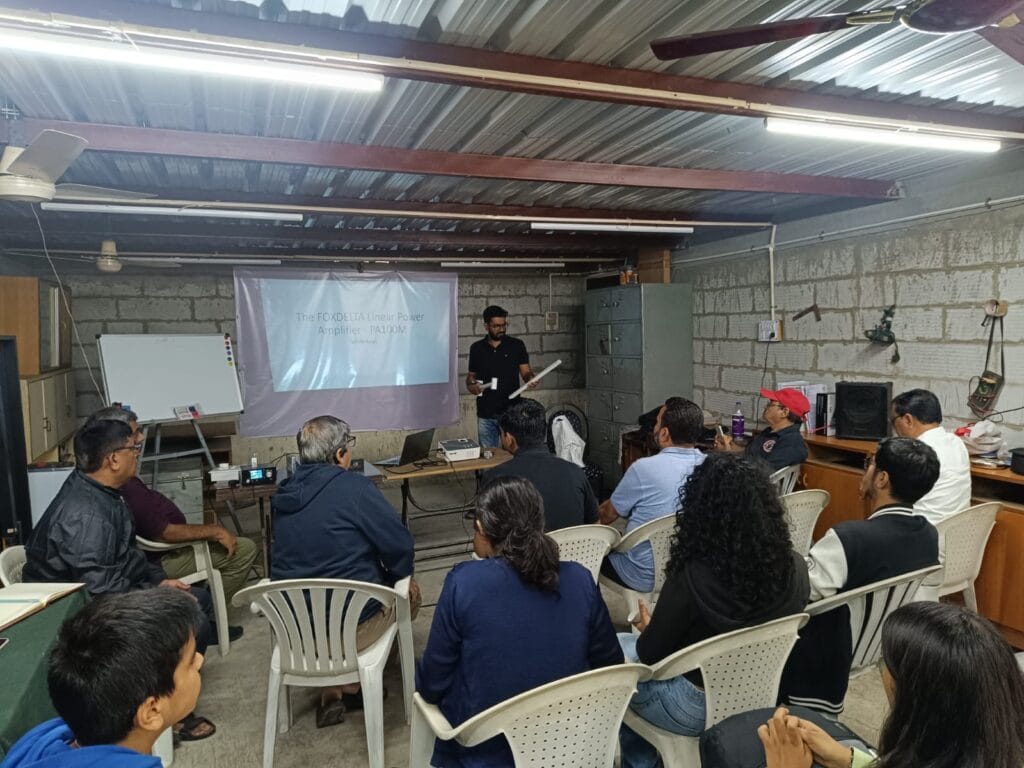
VU3IZK OM Ranga gave presentation and demonstrated Fox Delta make 70W HF Linear Amplifier using 50 Ohm 100W Dummy Load
The purpose of this demo was to support new comers on Air
Hundreds of Grade II QRP radio users ( like BiTx users ) are looking for a little boost to their 1 or 5 watt radios.
Fox Delta HF Linear Amplifier
PA-100M is a 50-70W IRF510 RF amplifier is the right solution.
it is not just an amp module but a complete Amplifier with interesting features such as:
- 4 X IRF510 as power amp with a driver IRF510
- Built-in dual channel SWR meter with PIC18F4550 which measures FWD/REF/SWR of the output stage and also measures INPUT forward power to the amplifier. A free PC software by Tony/I2TZK for bridge parameter config.
- PA-100M operates on any voltage range from 15V to 36V with 24-28 thought to be ideal. It may be powered from 12V too, with small mod.
- This amp is supplied in a metal case with heavy aluminum heat sink.
- On operating it using a handheld Mike with PTT connected to the transceiver HF signals microbitx V 6, the unit delivered a power of around 50 W as seen on its display.
- Visit https://www.foxdelta.in for more details about the power amp.
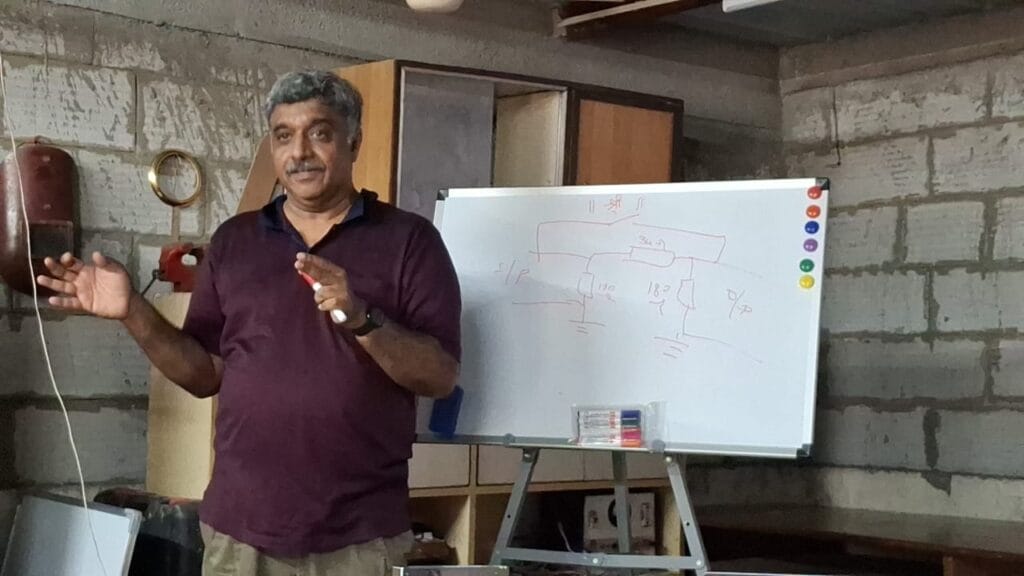
The live demo was most interesting and well received by young budding Hams from MIT Engg College.
VU3ZNE OM Parth announced two weeks Radio Astronomy Training Program in details.
Starting a Training Program in Radio Astronomy in July 2025
Enrollment started. Very Limited seats (max 20)
Focus is on School and College going students & JVP Members
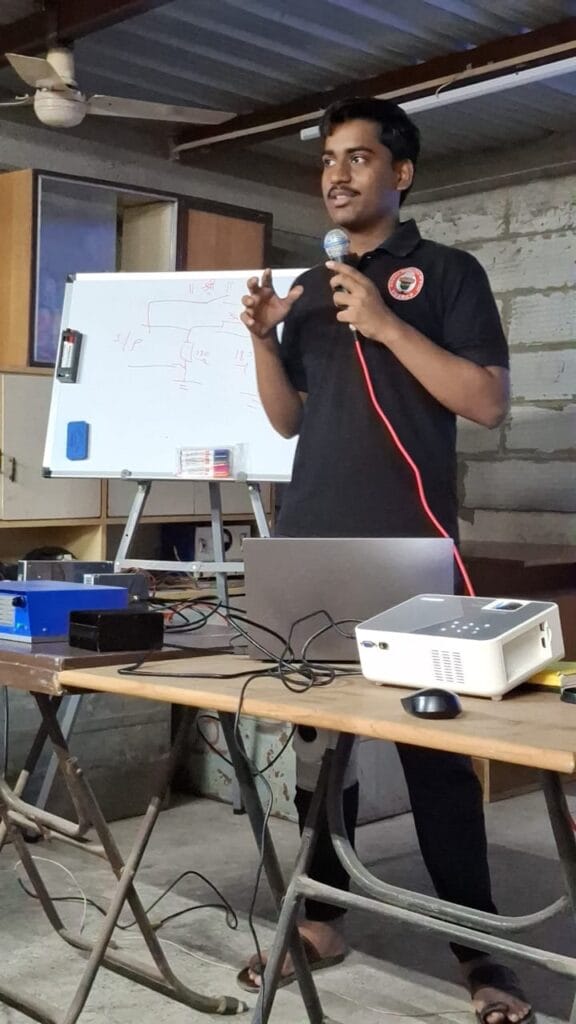
The Radio Astronomy group is formed for the participants of
2 weeks Workshop based on 21cm Radio Telescope made by VU3ZNE OM Parth Darade
A 21 cm radio telescope is a Galaxy observation type of radio telescope designed to detect the 21 cm hydrogen line, a spectral line emitted by atomic hydrogen. This line is important in astronomy because hydrogen is the most abundant element in the universe, making it a useful tracer for studying the distribution of gas in galaxies and the structure of the early universe.
The 21 cm line is a spectral line at a wavelength of 21 centimeters (or 1420.405 MHz frequency) emitted by atomic hydrogen.
This line arises from the “spin-flip” transition of the hydrogen atom’s electron, where it changes from an aligned to an anti-aligned spin state.
The 21 cm line is a narrow and well-defined line, making it a valuable tool for studying the distribution and velocity of hydrogen gas in galaxies and other astronomical objects.
The next Eyeball QSOMeet will be in MIT campus
Cosmos Club is the Host

Thanks to Prof Karne mam for Invitation.
Keep 3rd August 25 Sunday morning Free for next Eyeball QSO
73’s
Vila Rabde VU2VPR
Pune Hams VU2RCP
9822502078